
PyTorch Day India 2026: A builder-focused milestone for open source AI in Bengaluru
On February 7, 2026, the inaugural PyTorch Day India brought the open source AI community to Bengaluru for a full day of technical talks, discussions, and community connection. Co-organized by IBM, NVIDIA, and Red Hat, the event reinforced a clear theme: India is not only adopting AI at scale, it is helping define how production-grade, open AI systems are built.
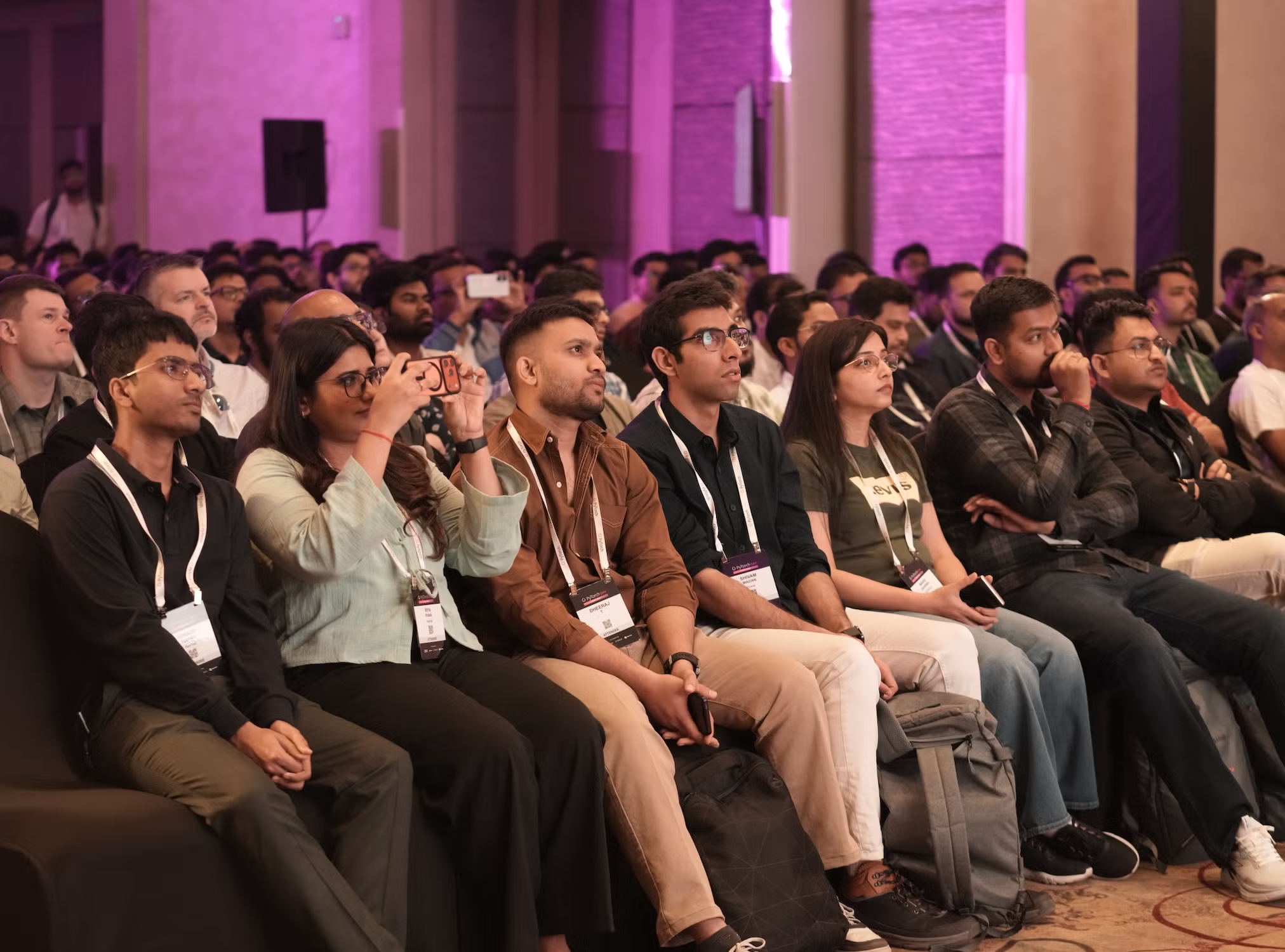
The in-person event was held in Bengaluru, placing the event at the center of one of India’s most active engineering ecosystems with 460 in-person attendees. The event was emceed by Raghu Ganti, IBM, who guided the day’s flow and helped keep the program cohesive and engaging.
Keynotes that framed the day: open platforms shaping the future of open source AI
A strong keynote trio anchored the event, reflecting the co-organizers’ complementary strengths across enterprise platforms, infrastructure software, and accelerated computing.
- Steve Watt (Red Hat): “Any Model, Any Accelerator, Any Cloud: How Open Source AI Unlocks the World’s Potential”
- Sriram Raghavan (IBM): “The Ubiquitous AI Platform: Lessons from Linux, Vision for PyTorch”
- Niket Agarwal (NVIDIA): “Full Stack AI Innovation: PyTorch + NVIDIA From Edge to Data Center”
Taken together, these talks pointed to the operational reality of modern AI, and how platforms like PyTorch and vLLM are laying the foundation for fast innovation from research to production
First, heterogeneous compute has become the default. Teams increasingly mix CPUs, GPUs, and specialized accelerators across cloud and on-premises environments, and they need frameworks and tooling that work consistently across those targets.
Second, AI platforms are increasingly treated as foundational infrastructure. The Linux comparison is instructive because long-lived platforms succeed when they provide stable interfaces, clear governance, and predictable behavior. That stability enables fast iteration above the platform and efficient optimization below it.
Third, end-to-end performance is now a primary product requirement, not an optional enhancement. “Edge to data center” captures the range of deployment patterns that organizations must support, from constrained inference at the edge to large-scale training, fine-tuning, and high-throughput serving in the data center.
What builders came for: kernels, compilers, inference, and real systems work
PyTorch Day India was deliberately technical and builder-oriented. The event emphasized low-level kernel to systems performance work, optimization, training efficiency, inference, and deployment concerns. This reflects where the field is heading: the hardest problems are about making robust and dependable AI systems under real constraints like latency, cost, reliability, security, and governance.
That builder emphasis also showed up in the ecosystem representation and talk topics. For example, Aritra Roy Gosthipaty and Sayak Paul (Hugging Face) highlighted kernel-level work in the Transformers ecosystem, signaling that practical performance engineering is now a first-class conversation for mainstream ML teams.
This focus matches how organizations deploy AI today. Most production AI is not a single model running in isolation. It is a workflow that connects data pipelines, distributed execution, training and evaluation, inference and serving, monitoring, and governance. As these components become more interdependent, open and composable building blocks become essential.
A keynote message worth carrying forward: open source is how AI becomes dependable
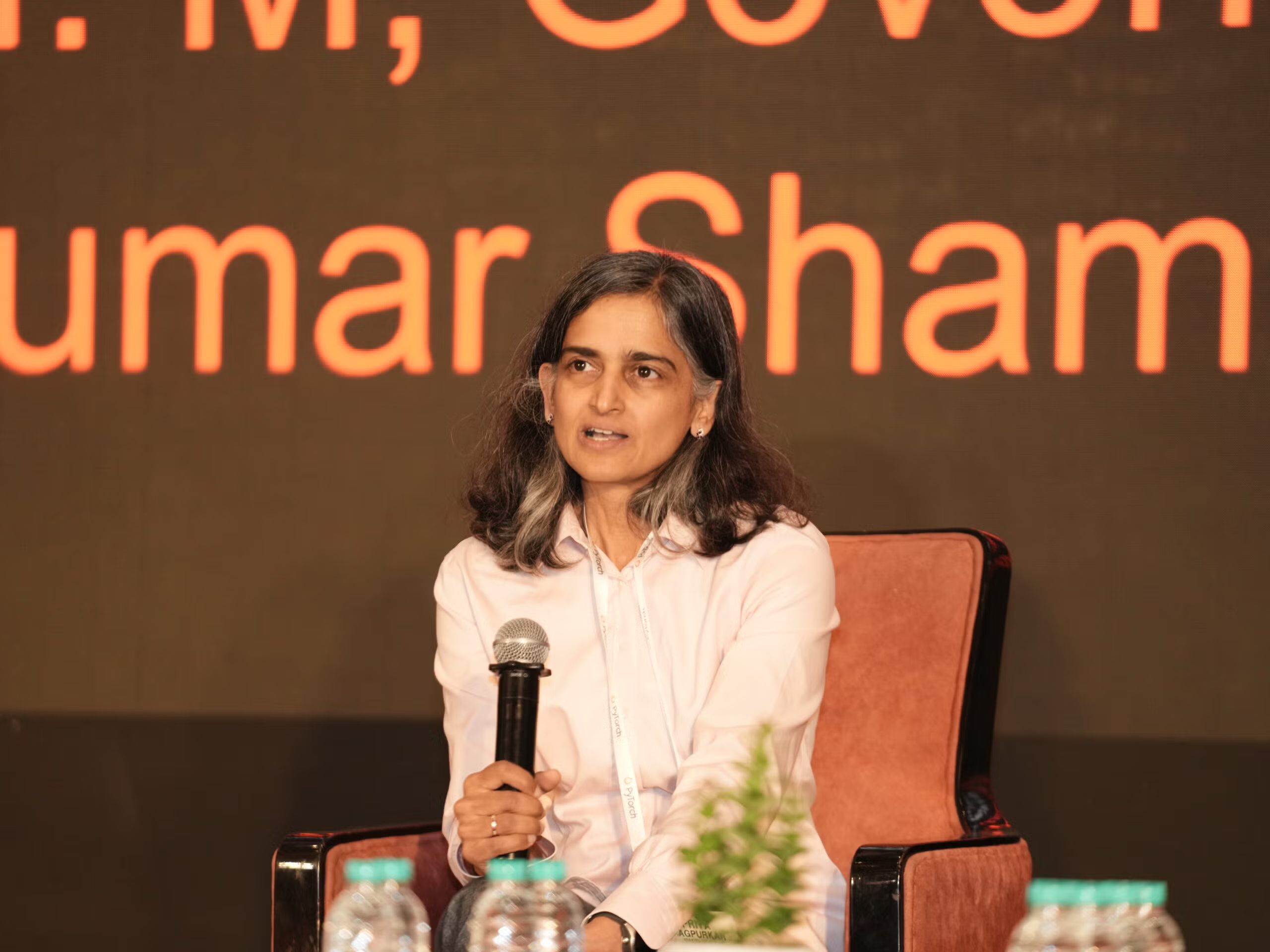
In his address, Matt White, PyTorch Foundation CTO and former Executive Director, emphasized a shift that is now common across enterprises. AI is moving from prototype to operational capability. That transition forces teams to prioritize engineering fundamentals, including reproducible training and evaluation, scalable inference, distributed compute and data pipelines, and security and supply-chain hygiene.
He also underscored a broader architectural trend: AI systems are becoming “systems of systems,” where models connect to retrieval, tooling, deployment, monitoring, and governance. In that environment, open source becomes a practical necessity because production adoption benefits from transparency, inspectability, and integration flexibility across complex infrastructure.
Why India matters to the PyTorch Foundation and the global ecosystem
India’s importance to the PyTorch ecosystem is structural.
It has developer scale, talent density, and a strong builder culture that translates research into production systems. It also has broad industry diversity, spanning global capability centers, fast-growing startups, academic institutions, and large enterprises serving both local and international markets. That mix accelerates feedback on what matters most in real deployments.
India also has a mature relationship with open source collaboration. That matters because open ecosystems thrive when communities do more than consume software. They improve it, document it, test it, build extensions, and create learning pathways that expand participation. Events like PyTorch Day India strengthen those pathways by turning knowledge-sharing into sustained contribution.
What comes next: build locally, contribute globally
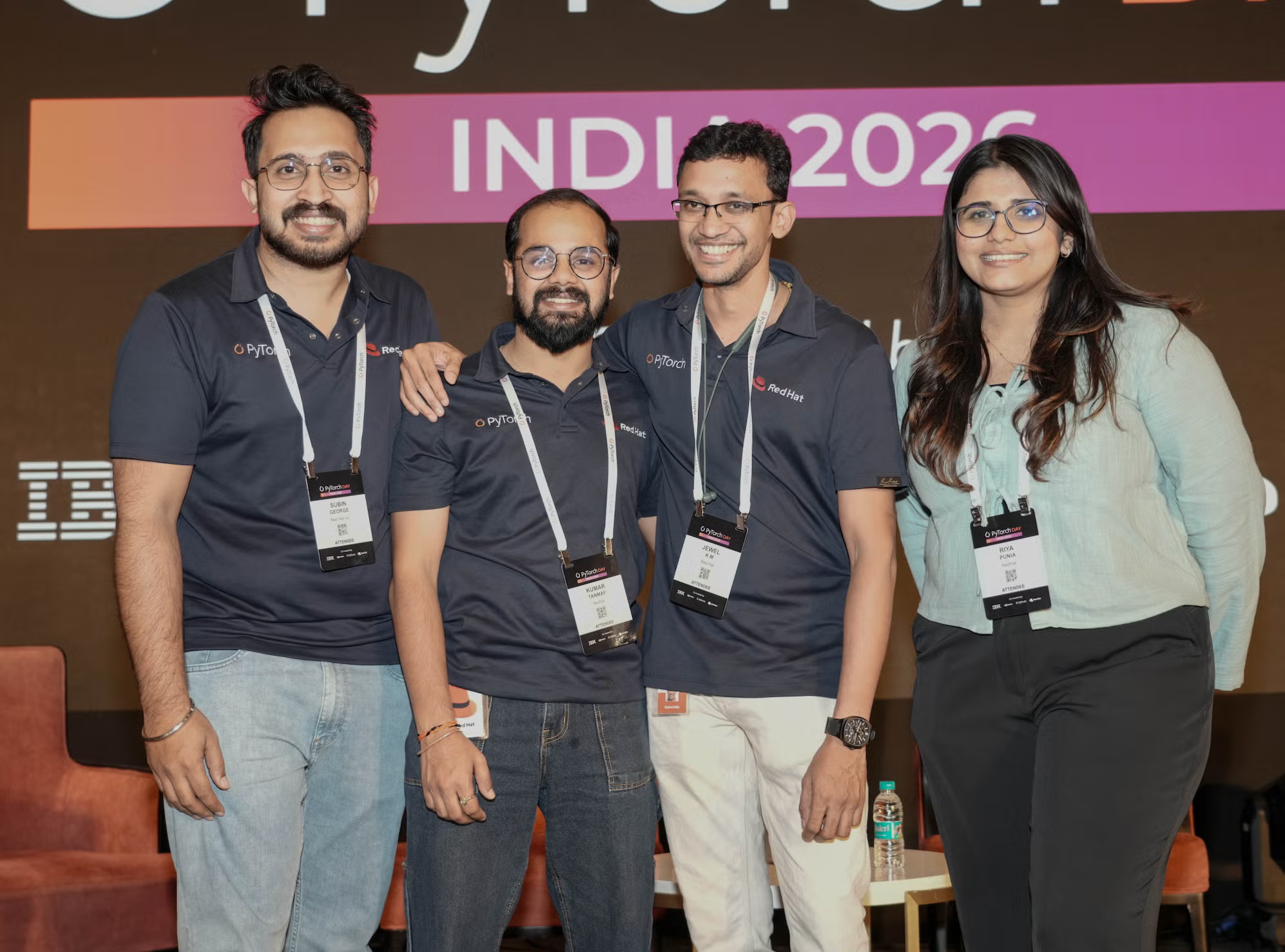
The most practical takeaway from the inaugural PyTorch Day India is that open source AI maturity is being shaped in many places at once, and India is clearly one of those places. Bengaluru was an appropriate setting, with its dense overlap of research, infrastructure engineering, product development, and startup execution.
For attendees, the next step is straightforward and high leverage: turn one idea from the day into an artifact that others can use. That might be a reproducible benchmark, a tutorial, a bug fix, a performance investigation, a documentation improvement, or a small but meaningful contribution to a project you rely on.
PyTorch Day India 2026 kept the focus where it belongs: on builders, on systems, and on the open technologies that make AI usable across industries and across the world. We hope to launch more PyTorch Day events in India and work together to build a strong, talent-rich, diverse, and cohesive open source AI ecosystem with the community in India.